


Page 16 - total-hip-packet
P. 16
RETURNING TO ACTIVITIES


        Total joint replacement surgery aims to reduce pain and return you to a more active lifestyle. We want you to have an
        active lifestyle, and we want this joint replacement to last a long time.

        RETURN TO A NORMAL WALKING PATTERN
        Most people with hip or knee arthritis have often changed how they walk or avoided putting all their weight on that leg
        to minimize their pain. This occurs slowly over time, and you may not even realize that you favor your other leg. You will
        need to use walking aids for a while after surgery, such as a walker or cane. The time required to use a walking aid varies
        from person to person. A physical therapist, based on your comfort level, can help determine which aid is best for your
        situation and when to progress. Getting back to walking normally after surgery will take time. Your walker handle height
        should make your elbows bend slightly. You can lift or slide your walker in front of you and then step towards it. When
        turning, make small movements and lift your operative leg to not pivot on it when it is planted on the floor.

        When you feel like you can and should transition to a cane, it should go in the opposite hand of the operative leg. Place
        the cane on the ground every time you plant your operative leg.

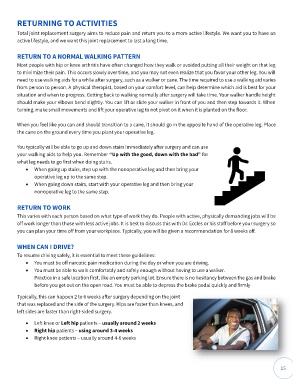
        You typically will be able to go up and down stairs immediately after surgery and can use
        your walking aids to help you. Remember “Up with the good, down with the bad” for
        what leg needs to go first when doing stairs.
            •  When going up stairs, step up with the nonoperative leg and then bring your
               operative leg up to the same step.
            •  When going down stairs, start with your operative leg and then bring your
               nonoperative leg to the same step.

        RETURN TO WORK
        This varies with each person based on what type of work they do. People with active, physically demanding jobs will be
        off work longer than those with less active jobs. It is best to discuss this with Dr. Eccles or his staff before your surgery so
        you can plan your time off from your workplace. Typically, you will be given a recommendation for 8 weeks off.

        WHEN CAN I DRIVE?

        To resume driving safely, it is essential to meet these guidelines:
            •  You must be off narcotic pain medication during the day or when you are driving.
            •  You must be able to walk comfortably and safely enough without having to use a walker.
               Practice in a safe location first, like an empty parking lot. Ensure there is no hesitancy between the gas and brake
               before you get out on the open road. You must be able to depress the brake pedal quickly and firmly

        Typically, this can happen 2 to 6 weeks after surgery depending on the joint
        that was replaced and the side of the surgery. Hips are faster than knees, and
        left sides are faster than right-sided surgery.

            •  Left knee or Left hip patients – usually around 2 weeks
            •  Right hip patients – using around 3-4 weeks
            •  Right knee patients – usually around 4-6 weeks


                                                                                                                      15

