


Page 18 - total-knee-packet
P. 18
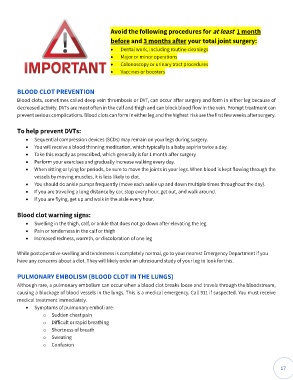
Avoid the following procedures for at least  1 month

                                               before and 3 months after your total joint surgery:
                                               •   Dental work, including routine cleanings
                                               •   Major or minor operations
                                               •   Colonoscopy or urinary tract procedures
                                               •   Vaccines or boosters


        BLOOD CLOT PREVENTION
        Blood clots, sometimes called deep vein thrombosis or DVT, can occur after surgery and form in either leg because of
        decreased activity. DVTs are most often in the calf and thigh and can block blood flow in the vein. Prompt treatment can
        prevent serious complications. Blood clots can form in either leg and the highest  risk are the first few weeks after surgery.

        To help prevent DVTs:
            •  Sequential compression devices (SCDs) may remain on your legs during surgery.
            •  You will receive a blood thinning medication, which typically is a baby aspirin twice a day.
            •  Take this exactly as prescribed, which generally is for 1 month after surgery
            •  Perform your exercises and gradually increase walking every day.
            •  When sitting or lying for periods, be sure to move the joints in your legs. When blood is kept flowing through the
               vessels by moving muscles, it is less likely to clot.
            •  You should do ankle pumps frequently (move each ankle up and down multiple times throughout the day).
            •  If you are traveling a long distance by car, stop every hour, get out, and walk around.
            •  If you are flying, get up and walk in the aisle every hour.

        Blood clot warning signs:
            •  Swelling in the thigh, calf, or ankle that does not go down after elevating the leg
            •  Pain or tenderness in the calf or thigh
            •  Increased redness, warmth, or discoloration of one leg

        While postoperative swelling and tenderness is completely normal, go to your nearest Emergency Department if you
        have any concerns about a clot. They will likely order an ultrasound study of your leg to look for this.

        PULMONARY EMBOLISM (BLOOD CLOT IN THE LUNGS)
        Although rare, a pulmonary embolism can occur when a blood clot breaks loose and travels through the bloodstream,
        causing a blockage of blood vessels in the lungs. This is a medical emergency. Call 911 if suspected. You must receive
        medical treatment immediately.
            •  Symptoms of pulmonary emboli are:
                   o  Sudden chest pain
                   o  Difficult or rapid breathing
                   o  Shortness of breath
                   o  Sweating
                   o  Confusion


                                                                                                                      17

