Muscle and Tendon-Sparing Knee Replacement in Gilbert, Queen Creek, Chandler and Mesa, AZ
If chronic knee pain is making walking, exercising, climbing stairs, or enjoying everyday activities difficult, muscle and tendon-sparing knee replacement may provide an approach designed to preserve healthy tissues while replacing damaged portions of the joint. Dr. Christian Eccles is a fellowship-trained, board-certified hip and knee replacement surgeon serving patients in Gilbert, Queen Creek, Chandler, and Mesa, AZ, with a focus on modern joint replacement, advanced technology, outpatient surgery, and recovery-focused care.
What Is Muscle and Tendon-Sparing Knee Replacement?
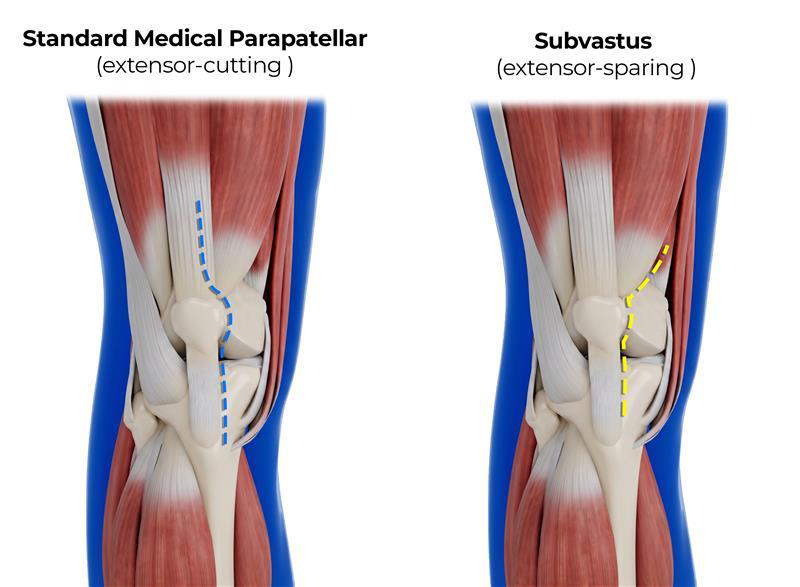
Muscle and tendon-sparing knee replacement refers to surgical techniques designed to minimize unnecessary disruption to the muscles, tendons, ligaments, and other healthy soft tissues surrounding the knee while treating damaged joint surfaces.
Rather than removing or disrupting more tissue than necessary, the surgeon carefully plans the procedure based on the patient's anatomy and the condition of the knee. Depending on the diagnosis, this philosophy may be incorporated into partial or total knee replacement.
The specific surgical approach is determined by the patient's anatomy, arthritis pattern, ligament condition, overall health, and type of knee replacement required. It is important to understand that no knee replacement is completely tissue-free or "non-invasive." The goal is appropriate preservation of healthy structures while safely replacing damaged joint surfaces.
What Are the Benefits of Muscle and Tendon-Sparing Knee Replacement?
When appropriate for the patient's condition, preserving healthy soft tissues may offer several potential benefits:
- Less disruption of surrounding muscles and tendons
- Support for earlier postoperative mobility
- Potentially less postoperative discomfort
- Earlier participation in rehabilitation
- Preservation of healthy knee structures when possible
- Potentially faster progression toward everyday activities
- Smaller or strategically placed incisions with certain techniques
- A more natural-feeling knee in selected partial replacement patients
The actual benefits depend on the procedure performed, the severity of joint damage, surgical technique, and individual recovery. Preserving healthy tissues should never compromise appropriate treatment of the damaged joint.
When Is Muscle and Tendon-Sparing Knee Replacement Recommended?
A tissue-preserving approach may be considered for patients who require knee replacement but have anatomy and disease patterns that allow healthy structures to be preserved. Potential candidates may include patients with:
- Advanced knee osteoarthritis
- Persistent knee pain and stiffness
- Difficulty walking or performing daily activities
- Symptoms that have not improved adequately with nonsurgical treatment
- Arthritis confined primarily to one compartment of the knee
- Healthy ligaments and remaining joint structures when considering partial replacement
- Overall health appropriate for surgery
Partial knee replacement can be particularly relevant when arthritis is limited to one compartment. However, patients with widespread arthritis or other structural problems may benefit more from total knee replacement.
What Does Preparation for Muscle and Tendon-Sparing Knee Replacement Involve?
Preparation begins with a detailed evaluation of your knee. Your surgeon will review your symptoms, medical history, previous treatments, medications, and imaging. X-rays and other imaging studies can help determine the extent and location of joint damage.
Your overall health will also be assessed before surgery. Patients may receive instructions about medications, nutrition, activity, exercises, and preparing their home for recovery.
Preoperative strengthening, sometimes called prehabilitation, may help prepare the muscles around the knee for postoperative rehabilitation. Arranging transportation and assistance at home may also be recommended.
How Is Muscle and Tendon-Sparing Knee Replacement Performed?
The exact technique depends on whether you need a partial or total knee replacement.
During partial knee replacement, the surgeon removes damaged bone and cartilage from the affected compartment while preserving healthy portions of the knee. Because only part of the joint is replaced, more of the patient's natural knee structures may remain intact.
During total knee replacement, damaged surfaces of the knee are replaced with prosthetic components. The surgeon works carefully around surrounding soft tissues to appropriately balance and position the implant.
Dr. Eccles also offers advanced technology-assisted knee replacement. Robotic systems and AI/navigation technology may be used in selected cases to assist with preoperative planning, alignment, bone preparation, and implant positioning.
What to Expect During Recovery After Muscle and Tendon-Sparing Knee Replacement?
Recovery varies according to the type of procedure and individual health. Patients generally begin moving the knee and walking soon after surgery when medically appropriate. Physical therapy focuses on restoring range of motion, strength, balance, and functional mobility.
Preserving healthy tissues may support an efficient rehabilitation process, but recovery is still gradual. Swelling, stiffness, and soreness are common during the early stages.
Dr. Eccles offers outpatient total knee replacement for appropriately selected patients. Patients who meet established safety and mobility criteria may be able to return home on the day of surgery and continue recovery with appropriate support and rehabilitation.
What Are the Risks and Complications of Muscle and Tendon-Sparing Knee Replacement?
Like other forms of knee replacement, this approach carries potential risks. These may include:
- Infection
- Blood clots
- Bleeding
- Persistent pain or swelling
- Knee stiffness
- Nerve or blood-vessel injury
- Implant loosening or wear
- Limited range of motion
- Continued symptoms
- Need for revision surgery
Your individual risks depend on your health, diagnosis, anatomy, surgical procedure, and other factors. Your surgeon will discuss these considerations during your consultation.
Why Choose Dr. Christian Eccles for Muscle and Tendon-Sparing Knee Replacement in Gilbert, AZ?
Dr. Christian Eccles is a fellowship-trained, board-certified orthopedic surgeon specializing in hip and knee replacement. He completed an Adult Reconstruction Fellowship at Indiana University after completing orthopedic surgery residency at the University of Louisville.
His practice focuses on adult joint reconstruction and incorporates modern treatment approaches, including robotic surgery, AI/navigation technology, outpatient joint replacement, and fast-recovery strategies for appropriately selected patients.
Patients from Gilbert, Queen Creek, Chandler, and Mesa, AZ, can receive specialized evaluation from a surgeon whose practice is dedicated to hip and knee reconstruction.
Muscle and Tendon-Sparing Knee Replacement FAQs
Is muscle and tendon-sparing knee replacement minimally invasive?
It may involve techniques intended to minimize disruption to surrounding tissues, but the exact approach depends on the procedure and patient's anatomy.
Does this approach mean muscles and tendons are never affected?
No. Knee replacement requires surgical access to the joint. The goal is to preserve healthy tissues when clinically appropriate while safely treating the damaged joint.
Is muscle and tendon-sparing surgery appropriate for everyone?
No. Candidacy depends on arthritis severity, location, ligament health, anatomy, overall health, and the type of replacement required.
Can robotic technology be used with tissue-preserving knee replacement?
In selected patients, robotic and navigation technologies may assist with surgical planning and implant positioning.
Will I recover faster with a tissue-sparing approach?
Potentially, but recovery varies. Your overall health, procedure, rehabilitation, and individual healing response all influence recovery.
Explore Muscle and Tendon-Sparing Knee Replacement in Gilbert, AZ
If knee arthritis is limiting your mobility and conservative treatments are no longer providing adequate relief, Dr. Christian Eccles can evaluate your knee and discuss appropriate replacement options. Serving patients throughout Gilbert, Queen Creek, Chandler, and Mesa, AZ, his practice combines specialized joint-replacement expertise with modern surgical technology and recovery-focused care. Contact the practice to schedule an evaluation and learn whether a muscle and tendon-sparing approach may be appropriate for you.