Total Hip Replacement Surgeon in Gilbert, Queen Creek, Chandler and Mesa, AZ
Total hip replacement removes damaged cartilage and bone from the hip and replaces them with artificial components, most often for arthritis that has not improved with non-surgical care. Dr. Eccles reviews whether hip replacement is appropriate and discusses anterior and posterior approach options.
What is a Total Hip Replacement?
Total hip replacement, also called total hip arthroplasty, is a surgical procedure in which the damaged cartilage and bone are removed from the hip joint and replaced with artificial components. The main indication for total hip replacement is arthritis.
Arthritis is the inflammation of joints, which results in pain, swelling, stiffness and limited movement. Hip arthritis is a common cause of chronic hip pain and disability.

Symptoms of Hip Arthritis
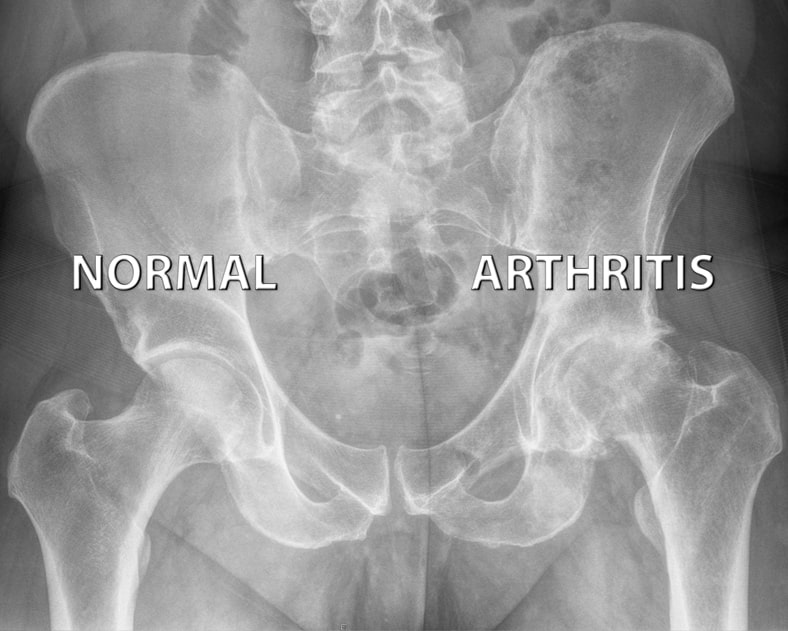
The hip is made up of the femoral head (top of the thigh bone) and acetabulum (socket of the pelvis). These two bones have soft cartilage ends that serve as a cushion and allow for smooth pain-free motion. Arthritis (inflammation of the joints), injury or other diseases of the joint can damage this protective cartilage layer. In an arthritic hip, the cartilage itself becomes thinner or completely absent where the bone ends often grind on each other. The most common symptom of hip arthritis is front-based groin pain and lack of motion. This pain and stiffness often causes limping and difficulty walking.
Diagnosis of Hip Arthritis
Diagnosis is made by evaluating your medical history, performing a physical examination, and taking X-rays of the painful joint.
Indications for Total Hip Replacement
Total hip replacement surgery is commonly indicated for severe osteoarthritis of the hip. Osteoarthritis is a type of arthritis. It is the most common form of hip arthritis in which the joint cartilage gradually wears away, and often affects the elderly. You may be a candidate for a total hip replacement if you have:
- Failure to obtain pain relief from medications, physical therapy or other conservative treatments
- Severe hip pain that limits your daily activities (such as walking, getting in and out of a car, or climbing stairs)
Total Hip Replacement Procedure
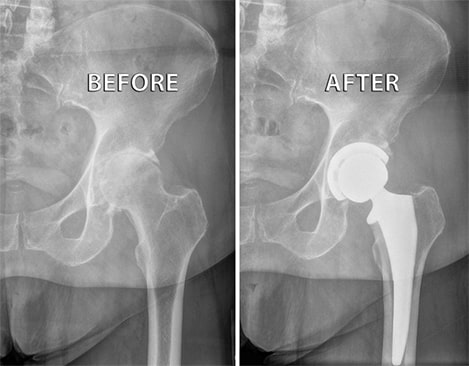
The goal of total hip replacement surgery is to relieve pain and restore the length of your hip before it had arthritis.
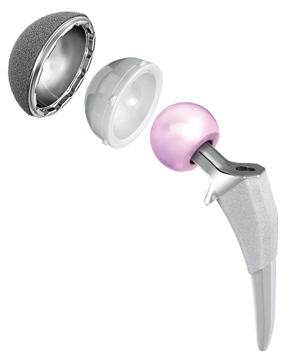
- The surgery is performed under a spinal block or general anesthesia. During the procedure, a surgical cut is made over the hip to expose the hip joint. The surface of the socket is cleaned and the damaged or arthritic bone is removed using a reamer. The acetabular cup component is inserted into the socket in a press fit manner, or occasionally using screws or bone cement. A liner made of plastic, is placed inside the acetabular component and serves as a smooth gliding surface.
- The femur or thighbone is prepared by removing the arthritic femoral head portion and preparing the femoral canal to accept a metal femoral component. This femoral component is then inserted into the femur either by a press fit or using bone cement. Then, the femoral head ball component made of ceramic is placed on the femoral stem. Both sides of the hip joint with the new components are put in their proper positions together. The entire joint is then irrigated and cleaned with a sterile solution. The incision is carefully closed and a sterile dressing is placed over the incision.
Total Hip Replacement Approaches
There are two main surgical approaches for hip replacement: the anterior (front) approach and the posterior (back) approach. Each has specific risks and benefits. The implants and overall long-term outcomes are the same, but patients typically experience faster recovery with the anterior approach. For this and other reasons, Dr. Eccles prefers the direct anterior approach.
- Learn more about Anterior Hip Replacement here:
https://www.southcarolinahipandknee.com/anterior-hip-replacement-hip-knee-replacement-specialist-gilbert-az/ - Learn more about Posterior Hip Replacement here: https://www.southcarolinahipandknee.com/posterior-hip-replacement-hip-knee-replacement-specialist-gilbert-az/
Postoperative Care following Total Hip Replacement
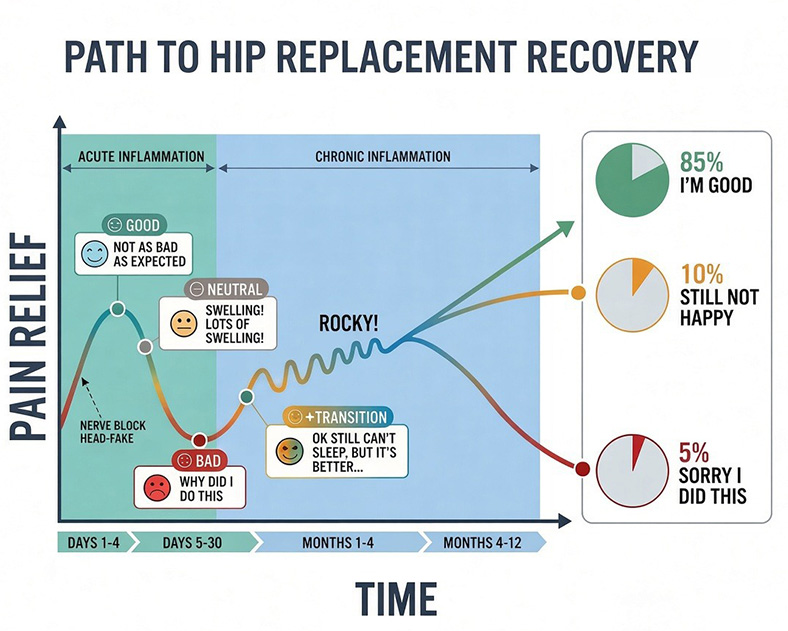
After undergoing total hip replacement, you will be given instructions of some of the common precautions that you should take for the first few weeks as your body recovers. Most patients are able to walk as much as they want immediately after surgery but will need a walker or a cane for a few weeks. Slowly increase your activity and over time the goal will be that you can get back to things that your hip arthritis prevented you from doing before surgery.
Recovery Timeline
Every recovery is different, but many patients follow a similar general pattern:
- Day of surgery: You will be up and walking with assistance within hours. Outpatient patients go home once discharge criteria are met.
- First two weeks: Focus on walking, home exercises, controlling swelling with ice and elevation, and caring for your incision.
- Weeks 2 to 6: Physical therapy builds strength and range of motion, and many patients move from a walker to a cane and then walk on their own.
- Weeks 6 to 12: Most daily activities become easier, and many patients return to driving and light work when cleared.
- Up to one year: Strength, endurance, and comfort continue to improve. Full recovery takes about a year because that is how long your body needs to heal.
Risks and Complications of Total Hip Replacement
- Infection
- Dislocation
- Fracture of the femur or pelvis
- Injury to nerves or blood vessels
- Formation of blood clots in the leg veins
- Leg length inequality
- Wearing out of the hip prosthesis
- Failure to relieve pain
- Loosening of the implant
If you would like to have additional information on the treatment of hip arthritis or would like to learn more about total hip replacement, please Contact Christian J. Eccles, M.D., serving the communities of Gilbert, AZ.
Why Choose Dr. Christian Eccles for Total Hip Replacement
Choosing a surgeon for total hip replacement is a big decision. Here is what you can expect from Dr. Eccles and our team:
- Specialized hip and knee replacement training: Dr. Eccles completed a five-year orthopaedic surgery residency at the University of Louisville and an Adult Reconstruction Fellowship in hip and knee replacement at Indiana University.
- Both surgical approaches: Dr. Eccles performs both anterior and posterior hip replacement, so your approach is chosen around your anatomy and needs rather than a one-size-fits-all technique.
- Technology-guided implant positioning: We use OrthoGrid Hip AI, an image-based navigation system that provides real-time measurements of cup position, leg length, and offset during surgery.
- Same-day surgery for selected patients: Appropriately selected patients can have total hip replacement at Arizona Spine and Joint Hospital and go home the same day.
- Two convenient Gilbert offices: We see patients at our North Gilbert and South Gilbert offices, close to home for families in Gilbert, Queen Creek, Chandler, and Mesa.
Total Hip Replacement FAQs
How long does total hip replacement surgery take?
A standard hip replacement typically takes 1 to 2 hours. You will also spend time before and after surgery being prepared and monitored.
How soon will I walk after surgery?
Most patients walk the same day with help from our physical therapy team. You will likely use a walker or cane for a few weeks as you build strength.
How long will my new hip last?
It depends on factors such as your activity level, weight, and bone quality, but modern implants typically last 20 to 30 years or more. Regular follow-up helps catch any problems early.
Can I go home the same day?
Many healthy patients who meet medical and physical therapy criteria go home the day of surgery. Dr. Eccles will only recommend outpatient surgery if it is safe for you.
Schedule Your Visit
If hip pain is limiting your life, a consultation can help you decide whether total hip replacement is right for you. Call (602) 648-5444 or request an appointment at our North Gilbert office (2940 E Banner Gateway Dr., Suite 200) or South Gilbert office (1675 E Melrose St., Suite 101).