Knee Replacement Surgery in Gilbert, AZ
Total Knee Replacement with Dr. Christian Eccles
When knee arthritis makes walking, climbing stairs, or sleeping painful, and therapy, medication, or injections no longer help, total knee replacement can relieve pain and restore movement. Dr. Christian Eccles is a fellowship-trained, board-certified hip and knee replacement surgeon who cares for patients in Gilbert, Queen Creek, Chandler, and Mesa, AZ. Depending on your knee, he may use specialized guides, computer navigation, or robotic assistance to prepare the bone and position your implants.
What Is a Total Knee Replacement?
Total knee replacement, also called total knee arthroplasty, is a procedure in which the worn or damaged surfaces of the knee joint are removed and replaced with an artificial joint (prosthesis) made of metal and plastic components. The most common reason for the surgery is arthritis, a condition that causes joint pain, swelling, stiffness, and limited movement.

Symptoms of Knee Arthritis
Your knee is made up of the thighbone (femur), shinbone (tibia), and kneecap (patella). Two C-shaped pads of cartilage called menisci sit between the femur and tibia to cushion the joint and absorb shock. In an arthritic knee, the smooth cartilage covering the bones becomes thin or wears away completely, and bony spurs can form around the edges of the joint. You may notice:
- Pain with walking, standing up from a chair, or climbing stairs
- Stiffness, especially in the morning or after sitting
- Swelling that comes and goes or does not settle with rest
- Grinding, catching, or a feeling that the knee may give way
- Reduced range of motion or a visible bow-legged or knock-kneed shape
Learn more about knee arthritis and its nonsurgical treatment.
How Knee Arthritis Is Diagnosed
Diagnosis begins with a review of your medical history and symptoms, followed by a physical examination of your knee and X-rays to show how much cartilage has worn away and whether the joint has lost its normal alignment.

Am I a Candidate for Knee Replacement?
Total knee replacement is most often recommended for severe osteoarthritis, the form of arthritis in which joint cartilage gradually wears away. You may be a candidate if you have:
- Pain that has not improved with medication, steroid injections, physical therapy, or other conservative treatment
- Severe knee pain that limits daily activities such as walking, getting up from a chair, or climbing stairs
- Moderate to severe pain at rest or pain that wakes you at night
- Chronic swelling and inflammation that do not improve with rest or medication
- A bow-legged or knock-knee deformity
Age alone does not decide candidacy. Your overall health, activity goals, and how much the knee affects your quality of life all matter. If you have not yet tried nonsurgical care, options such as an intraarticular knee injection may be discussed first. For a closer look at the decision, read Am I a Candidate for Joint Replacement Surgery?
Total Knee Replacement Procedure
The goal of surgery is to relieve pain and restore the alignment and function of your knee. The procedure is performed under spinal or general anesthesia and generally follows these steps:
- Dr. Eccles makes an incision over the knee to expose the joint.
- The damaged ends of the femur and tibia are trimmed at precise angles using specialized guides, computer navigation, or robotic assistance, removing the arthritis and any bony growths.
- Metal components are fixed to the prepared bone, either with bone cement or, when bone quality allows, with a press-fit (cementless) technique.
- A plastic insert is placed between the metal components to create a smooth gliding surface. When needed, the back of the kneecap is also resurfaced with a plastic component.
- The knee is tested through its full range of motion, the joint is irrigated with a sterile solution, and the incision is closed and dressed.

Surgical Options for Knee Replacement
Every knee is different, so the technique and recovery pathway are matched to your anatomy, health, and goals. Options Dr. Eccles offers for appropriately selected patients include:
Robotic knee replacement: Robotic technology helps Dr. Eccles plan the operation around your own knee anatomy and guides bone preparation and implant positioning during surgery. He uses the TMINI® Miniature Robotic System, a handheld robotic platform that works from a patient-specific 3D plan. The surgeon remains in control throughout.
Minimally invasive knee surgery: This approach reaches the joint through smaller or carefully placed incisions with less disturbance of surrounding tissue. Whether it suits you depends on your anatomy and the extent of joint damage.
Muscle and tendon-sparing knee replacement: The focus here is on protecting healthy muscles, tendons, and ligaments while the damaged surfaces are replaced. Preserving these structures may help you start moving and rehabilitating sooner.
Outpatient and fast recovery knee surgery: If you are healthy and meet medical and therapy criteria, you may be able to go home on the day of surgery. Modern anesthesia techniques such as a regional nerve block, along with early walking and a structured rehabilitation plan, support a safe return home. Outpatient surgery is only recommended when it is safe for you.
Narcotic-free knee replacement: Pain is managed with a combination of regional or local anesthesia, non-opioid medication, ice, elevation, and early therapy, with the aim of reducing or avoiding opioids. The plan is tailored to you, and additional medication is used if needed to keep you comfortable.
Postoperative Care Following Total Knee Replacement
Rehabilitation starts right after surgery. A physical therapist will help you get up and walk, usually with a walker at first, and teach you exercises to strengthen your leg and restore knee motion. You will also receive a home exercise program for your thigh and calf muscles. Reviewing the pre-op and post-op knee guidelines and exercises before and after surgery ahead of time can help you prepare.
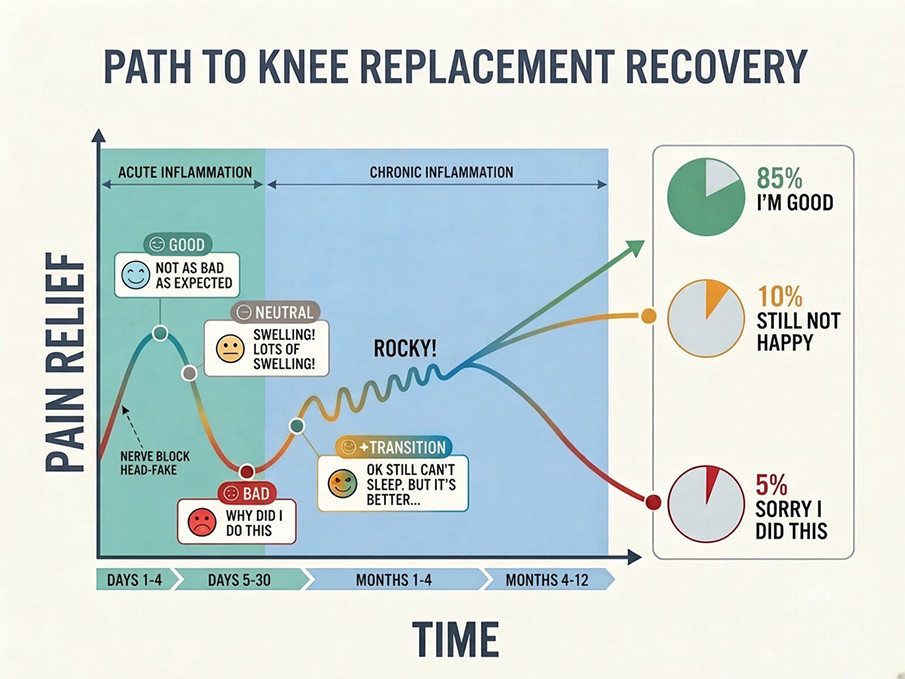
Recovery Timeline
Every recovery is different, but many patients follow a similar general pattern:
- Day of surgery: You will be up and walking with assistance within hours. Outpatient patients go home once discharge criteria are met.
- First two weeks: Focus on walking, home exercises, controlling swelling with ice and elevation, and caring for your incision.
- Weeks 2 to 6: Physical therapy builds strength and range of motion, and many patients move from a walker to a cane and then walk on their own.
- Weeks 6 to 12: Most daily activities become easier, and many patients return to driving and light work when cleared.
- Up to one year: Strength, endurance, and comfort continue to improve. Full recovery takes about a year because that is how long your body needs to heal.
Risks and Complications of Total Knee Replacement
As with any major surgery, knee replacement carries risks. Most complications are uncommon, but they can include:
- Knee stiffness
- Infection
- Blood clots (deep vein thrombosis)
- Nerve or blood vessel damage
- Ligament injury
- Kneecap (patella) dislocation
- Wear of the plastic liner
- Loosening of the implant
If a Knee Replacement Fails
Most knee replacements last for many years, but some develop problems. Ongoing pain, swelling, instability, or stiffness after surgery should be evaluated to find the cause. Learn more about painful or failed total knee replacement. In a small percentage of patients, infection can develop around the implant. This is called periprosthetic knee infection and requires prompt specialist care. When an implant wears out, loosens, or becomes infected, revision knee replacement replaces part or all of the original prosthesis.
Why Choose Dr. Christian Eccles in Gilbert, AZ?
Dr. Christian Eccles is a fellowship-trained, board-certified orthopedic surgeon whose practice is dedicated to hip and knee replacement. He completed his orthopedic surgery residency at the University of Louisville and an Adult Reconstruction Fellowship at Indiana University, where he trained under national hip and knee replacement experts. He is a member of the American Academy of Orthopaedic Surgeons and the American Association of Hip and Knee Surgeons, and has published research on robotic-assisted knee replacement and on reducing opioid use after knee surgery. Patients from Gilbert, Queen Creek, Chandler, and Mesa can expect an individualized plan that combines advanced technology with a focus on a safe, comfortable recovery.
Knee Replacement FAQs
How long does a knee replacement last?
Most modern knee replacements can last 25+ years. How long yours lasts depends on factors such as your activity level, weight, bone quality, and implant fixation. Regular follow-up helps catch problems early.
Will I be able to go home the same day?
Most likely. Same-day discharge is available for appropriately selected patients who are in good health and meet medical and physical therapy criteria after surgery. Dr. Eccles will only recommend it if it is safe for you.
Is robotic knee replacement right for me?
Robotic assistance can help with planning and implant positioning, but it is not automatically the best choice for every knee. Your exam and imaging will help determine whether it is appropriate.
How much pain will I have after surgery?
Some soreness and swelling are normal. A multimodal pain plan that combines regional anesthesia, non-opioid medication, ice, and early movement aims to keep you comfortable while limiting opioid use.
When can I drive after knee replacement?
Many patients return to driving within several weeks, once they are off opioid pain medication and can control the vehicle safely. Dr. Eccles will advise you based on your recovery and which knee was replaced.
Take the Next Step
If knee pain is limiting your daily life, a consultation can help you understand your options, from nonsurgical care to total knee replacement. Call (602) 648-5444 to schedule a visit.
Request an appointment with Dr. Eccles in Gilbert, AZ.