Dr Christian Eccles, Posterior Hip Replacement Surgeon in Gilbert, Queen Creek, Chandler and Mesa, AZ.
Posterior hip replacement is the traditional approach to total hip replacement. Dr. Eccles makes the incision at the side of the hip near the buttocks and replaces the damaged joint surfaces without cutting the major abductor muscles used for walking.
What is Posterior Hip Replacement Surgery?
Posterior hip replacement is a surgical procedure in which the worn out or damaged surfaces of the hip joint are removed and replaced with artificial joint components made of metal, ceramic, and plastic. The posterior approach is traditionally the most common approach used to perform a total hip replacement. In a posterior hip replacement, the surgeon makes the hip incision at the side of the hip close to the buttocks to gain access to the backside (posterior) aspect of the hip joint to perform the replacement. The incision is placed so the abductor muscles, the major walking muscles, are not cut.
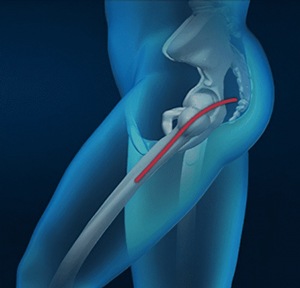
Posterior Hip Replacement Procedure
- Posterior hip replacement surgery is performed under general anesthesia or regional anesthesia. During the procedure, you will lie on your side in a lateral position.
- A surgical cut is made along the side of the hip to expose the hip joint and the femur is dislocated from the acetabulum.
- The surface of the socket is cleaned and the damaged or arthritic bone is removed using a reamer. The acetabular cup component is inserted into the socket in a press fit manner, or occasionally using screws or bone cement. A liner made of plastic, is placed inside the acetabular component and serves as a smooth gliding surface.
- The femur or thighbone is prepared by removing the arthritic femoral head portion and preparing the femoral canal to accept a metal femoral component. This femoral component is then inserted into the femur either by a press fit or using bone cement. Then, the femoral head ball component made of ceramic is placed on the femoral stem. Both sides of the hip joint with the new components are put in their proper positions together. The entire joint is then irrigated and cleaned with a sterile solution. The incision is carefully closed and a sterile dressing is placed over the incision.
Risks and Complications of Posterior Hip Replacement
All surgeries and various approaches to the hip carry an element of risk, whether it is related to the anesthesia or the procedure itself. Risks and complications with posterior hip replacement are rare, but can occur and may include:
- Dislocation
- Leg length inequality
- Infection at the incision site or joint space
- Fracture of the femur or pelvis
- Injury to nerves or blood vessels
- Formation of blood clots in the leg veins
- Wearing out of the hip prosthesis
- Failure to relieve pain
- Loosening of the implant
Advantages of Posterior Hip Replacement
The advantages of posterior hip replacement include:
- Less likely to have intraoperative fractures
- Less likely to have skin incision healing issues
- Allows excellent visibility of the joint
- More extensile approach
Why Choose Dr. Christian Eccles for Posterior Hip Replacement
The posterior approach remains a trusted, versatile option for hip replacement. Here is why you can feel confident choosing Dr. Eccles:
- Specialized training: Dr. Eccles completed a five-year orthopaedic surgery residency at the University of Louisville and an Adult Reconstruction Fellowship in hip and knee replacement at Indiana University.
- Protecting the muscles you walk with: Dr. Eccles places the incision so the abductor muscles, the major muscles you use for walking, are not cut.
- A versatile approach for complex hips: The posterior approach gives excellent visibility of the joint and can be extended if needed, which can be helpful in more complex cases.
- Unbiased recommendations: Because Dr. Eccles performs both posterior and anterior hip replacement, we will recommend the approach that best suits your hip.
- Two convenient Gilbert offices: We see patients at our North Gilbert and South Gilbert offices, close to home for families in Gilbert, Queen Creek, Chandler, and Mesa.
Posterior Hip Replacement FAQs
Why might the posterior approach be recommended for me?
It is associated with a lower chance of fractures during surgery and fewer incision healing problems, and it allows excellent visibility of the joint. It may be a good fit if your hip anatomy is complex or you have had previous hip surgery.
What precautions will I need after surgery?
You may be asked to avoid bending your hip past 90 degrees, crossing your legs, or turning your foot inward for a period of time. We will give you clear instructions before you go home.
Is dislocation a concern with posterior hip replacement?
Dislocation is a known risk with any hip replacement, and following your precautions helps lower it. Dr. Eccles will review your individual risks with you before surgery.
Are the implants different from anterior hip replacement?
No. The implants and overall outcome are the same; the difference is how Dr. Eccles reaches the joint.
Schedule Your Visit
Find out whether posterior hip replacement is right for you. Call (602) 648-5444 or request an appointment with Dr. Eccles at our North Gilbert office (2940 E Banner Gateway Dr., Suite 200) or South Gilbert office (1675 E Melrose St., Suite 101).